
MSP automation has moved from a competitive advantage to table stakes. 95% of the industry agrees it's no longer optional, but 44% of MSPs are stuck in the middle — past the basics, not yet scaling. Falling behind doesn't look like failure. It looks like winning internally, but not turning those wins into revenue, and watching your clients figure out AI and automation without you.
I talk to MSPs all the time. When someone asks me what falling behind on automation looks like, I tell them it's not what they imagine.
It's usually not a lack of automation talent. It's leadership assuming that their technical people are automating what needs to be automated. It’s not setting and tracking goals that connect to what's actually driving the business forward.
The mid-levels of maturity are about getting your house in order, streamlining processes and eliminating repetitive work. Those things should be freeing up time to take those same wins to customers. I often see MSPs getting the wins, getting more profitable, but not turning that into a revenue stream. That's where the drop-off happens.
Our 2026 State of MSP Automation report, based on responses from 300 MSP professionals, puts numbers behind what I see every day.
Why are most MSPs stuck in the middle?
95% of the industry agrees automation isn't optional. 97% plan to automate more this year. The buy-in is there. So is the ambition.
But 44% of MSPs are at Level 3 — what the report calls Operationalizing, the midpoint on a five-level maturity scale. They’ve moved past the basics but haven’t reached the point where automation runs consistently across the whole business. Only 4% have reached Level 5: fully scaled.
The blocker isn't the budget. Budget came in last at 18% among barriers cited. The top obstacles are a lack of expertise (54%) and not knowing what to automate next (48%). That's a problem of capability and clarity.
What I see at Level 3 is leaders coming in with big ideas. They want to automate all of customer service or some other massive process. And that's where they stall. Aharon's first law of automation is that you can't automate a process that doesn't exist. They get stuck trying to automate something they can't even define.
You also can't eat the elephant in one bite. Your first automation projects should be small. Find something manageable, prove it works, and you get that rush — “I automated this thing, it's off my plate, I saved 30 minutes a week.” It's not huge. But now you can spend that 30 minutes building the next one. Start small, pick up steam, and get bigger. Those small automations become the building blocks for the bigger processes. Just don't try to do it all on day one.
What's different about MSPs with a dedicated automation platform?
MSPs with a dedicated automation platform are delivering Automation as a Service at more than double the rate of those without: 23% versus 9%. 41% of MSPs using AI for decision-making inside their automations reported significant revenue growth, compared to 33% across the overall sample — and they’re 43% more likely to already be delivering Automation as a Service.
Without using an automation platform, you typically either rely on someone chatting with an AI and getting responses, or someone is writing source code and building their own “custom” infrastructure. Either way, that knowledge is in one person’s head and you don’t have a repeatable process. When that person leaves, everything they’ve built often gets thrown out and replaced when someone new takes their place.
With an automation platform, you have something with structure. Something that looks like a flowchart. You can follow it, understand it, and bring somebody else in to maintain it. That's something the whole team can own.
81% of platform users say automation is essential to their strategy compared with 58% among those without one. Platform users are also using AI to build automations at 71%, compared with 38% for non-platform users.
AI helps. But it doesn't replace good judgment.
When I explain AI to someone who isn't a technical person, I start with two concepts: determinism and probabilism.
AI thinks in probabilities. It predicts how a process should work and go forward. That makes it good at brainstorming, design, and helping you work through logic. But it's not great at doing the same thing the same way every time.
When you build a deterministic automation, if your inputs are A, B, and C, your outputs will always be X, Y, and Z. That's what creates something you can depend on and resell. If you rely strictly on AI, it may work today, but it may not work the same way every time. It won't hold up long-term when inputs change or a new AI model drops.
What AI can help with is planning what to automate, but only if you're feeding it the right information. The MSPs who are succeeding with AI are having the right conversations with stakeholders — asking what would take things off people's plates, what would make their jobs easier. They begin to understand how automation and AI fit into their strategic goals.
Then they begin having strategic conversations with customers, not just internally.
MSPs can't just keep talking to a customer about how well the computers are running or whether there were any network outages this month. That's not driving value. You drive value by improving the bottom line. If you can make a customer's production 5% more effective, that's a much bigger win. That's something that proves your value. It's a much more productive partnership.
“Automation was never about reducing headcount. It’s about augmenting our team members and empowering them to redirect their time and energy to higher value work our clients notice.” — Chris Harp, COO, Matson & Isom
The cost of waiting
No one knows what the next 6, 12, 18 months is going to look like. Things are moving faster than anyone expected, and the speed of innovation is still increasing. If you're behind now, you're going to be twice as far behind in a year.
I wouldn't say you'll be out of business. But you'll have a lot of catching up to do.
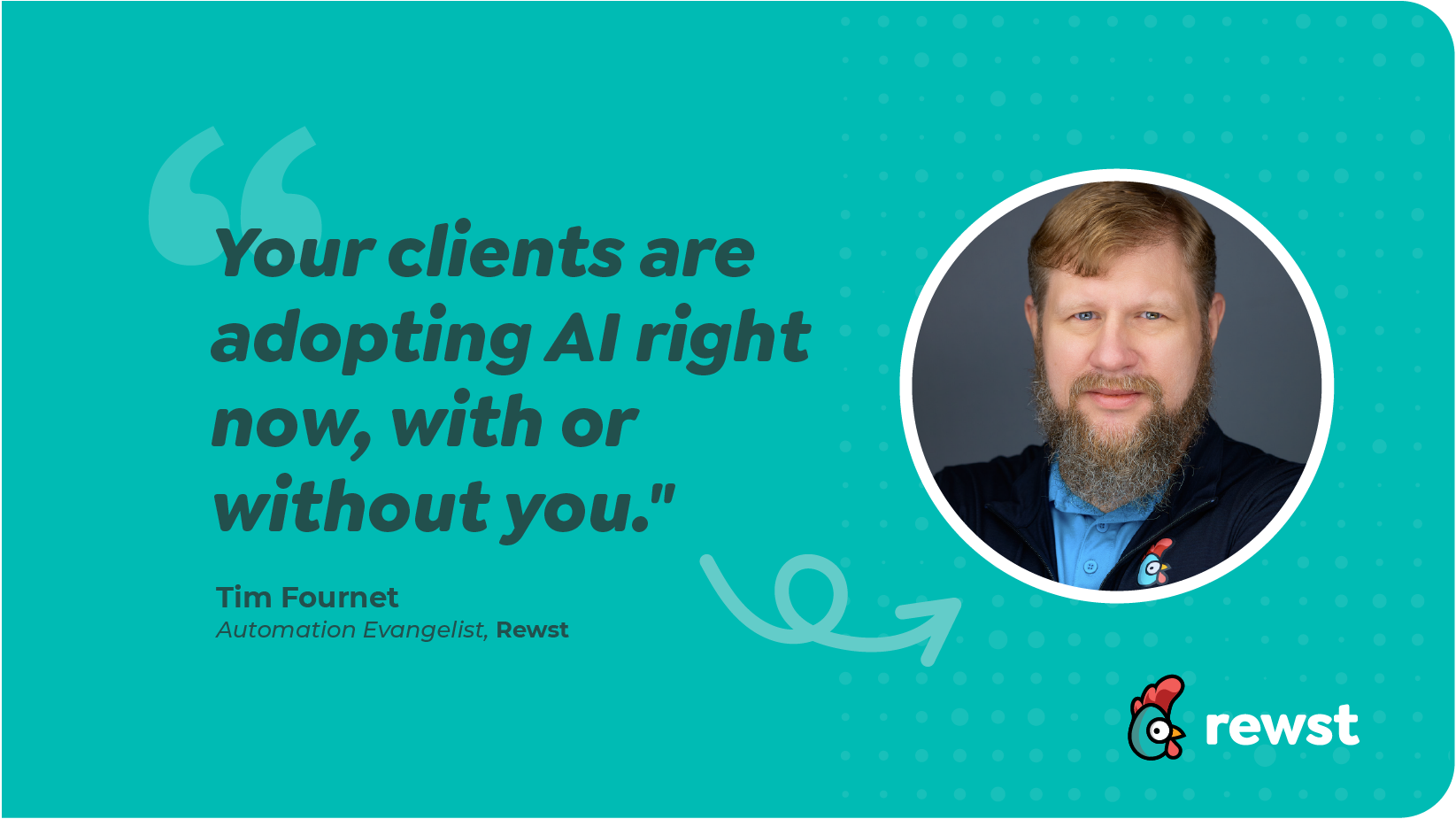
Here's what most people don't think about: it's probably not going to be the competitors that pass you by first. It'll be your clients. They see ads for OpenAI, Anthropic, and others daily. They're picking up these tools. They're connecting their systems to AI. They're going to find automation platforms. They're going to do this with or without your guidance. If you try to block them, they'll get mad and leave. If you don't help them, they'll figure it out on their own – but they will make a lot of mistakes along the way.
As an MSP, you can’t ignore AI. You can’t (successfully) expect your customers to, either.
Your value as an MSP has always been your ability to navigate through responsible adoption of technologies. You've done it for years. If you're not a thought leader in how to use AI and automation, your customers will find somebody who is.
The gap is still closeable. But it won't stay that way. The MSPs making moves now are building an advantage that gets harder to close every quarter they're ahead.
See where you stand
If you want to see the full picture — where the industry is, where the gaps are, and what's separating the MSPs who are scaling from the ones who are stuck — the 2026 State of MSP Automation report has the data.
The most useful first step is giving someone in your organization permission to start. Not to automate everything. Just one thing. If you've got the right people, they should be excited about this. Give them room to run.
→ Download the 2026 State of MSP Automation Report

Related Posts
Welcome to the new Rewst, where whoever understands the problem can solve it.
Most MSP shops have figured out by now that ChatGPT or Claude can generate PowerShell scripts and API calls on demand. ...