There’s no shortage of opinions about AI and automation. Most of them blur the two together and quickly stop being useful.
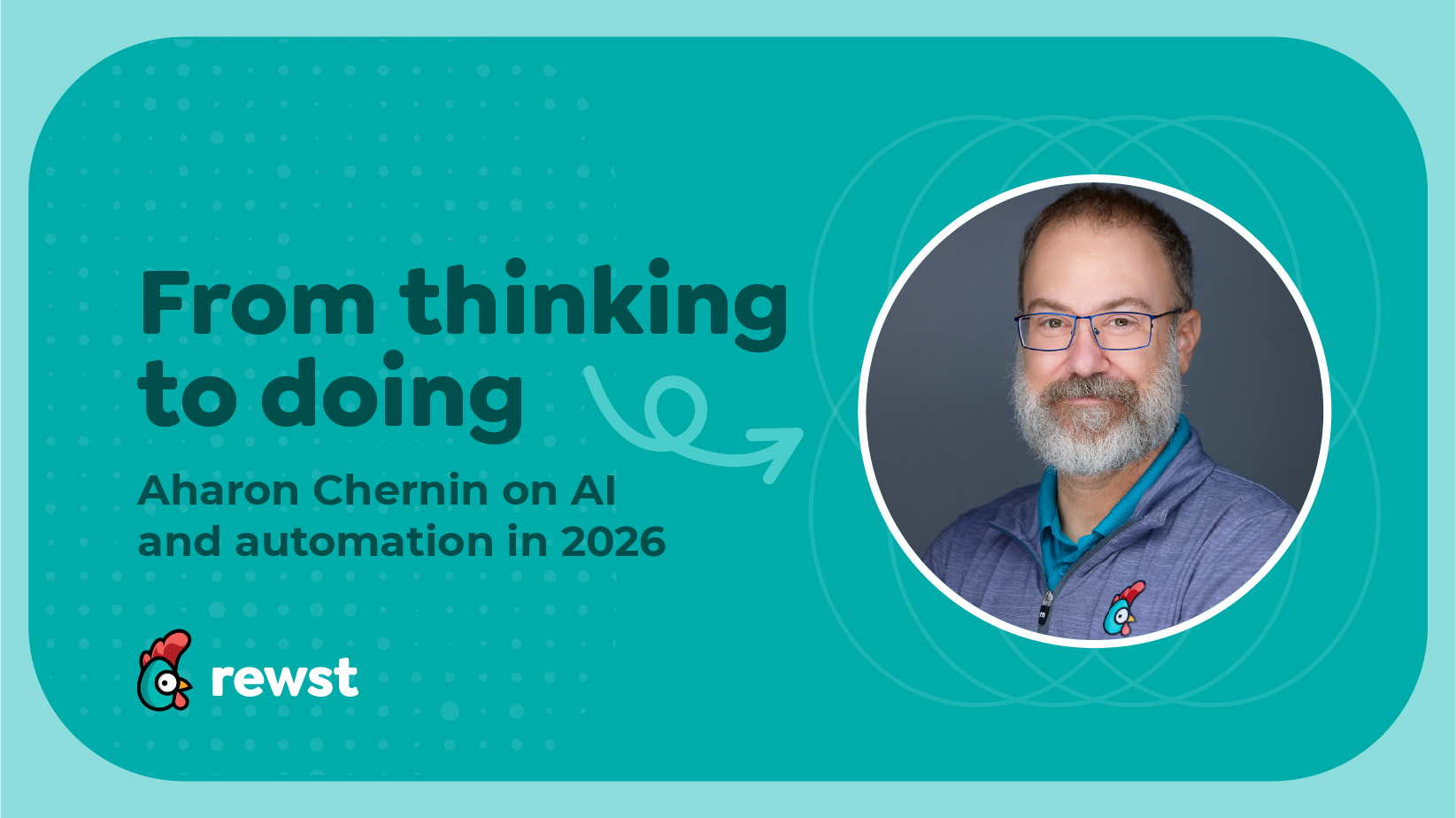
That’s why we sat down with Aharon Chernin, CEO of Rewst, to talk through how he’s thinking about AI and automation as we head into 2026.
Aharon built Rewst by wrestling with the kinds of problems MSPs don’t get to ignore. Multiple tenants. Too many tools. Processes that break the moment they’re handled differently twice. Those constraints shape how he approaches AI, where it belongs, and where it doesn’t.
The conversation centered on a simple idea he keeps coming back to: AI thinks. Automation does. From there, the conversation moved into where that distinction matters, why it changes how MSPs operate, and what happens when automation isn’t treated like side work anymore (hint: it’s not just time savings).
What are you most excited about right now when it comes to automation and AI?
AI is making it easier to build automation. That lowers the barrier to entry for MSP teams that want to start automating without spending months learning new tools or frameworks first. It also helps MSPs realize value from their investment faster.
At the same time, automation is what gives AI a way to act inside systems. AI helps reason through a problem and recommends what should happen next. Automation takes those decisions and executes them. Humans help validate the decision before the action happens.
That distinction matters to MSPs that are deciding which tool to apply within their own technical stack and workflows. AI reasons. Automation executes.
How should business leaders be thinking about automation and AI in 2026?
MSPs should treat AI and automation together as a differentiator for how they deliver service.
When teams apply them as a complementary pair, service delivery becomes faster and more consistent. Errors drop. Response times improve. Customers experience that difference even if they never see the automation behind it.
Leaders will benefit from framing the value of automation beyond employee and process efficiency. By improving internal MSP operations and applying automation and AI to tackle meaningful business problems, together they deliver strategic value and improve the customer experience, even as an MSP grows.
Many people treat AI and automation as the same. How do you see them working together, and where does each excel?
They serve different roles.
AI works well for planning and decision support. Automation handles execution inside tools.
You can ask an AI system to explain how a ConnectWise PSA workflow should operate. AI outlines the logic and steps to set up and manage the workflow. It cannot apply categories, route tickets, or trigger actions inside the platform. Automation exists to do that work.
When those roles are clear, MSPs get a clean path from planning a workflow to running it inside their tools.
What’s the spiciest automation take you have right now?
If automation is treated as extra work or purely as a way to save time, it’s unlikely to stick and create big value.
That mindset usually shows up early, when automation isn’t tied to clear business goals. Without that connection, it’s harder to involve the right technical and process owners, prioritize the right workflows, or track KPIs that drive meaningful outcomes.
When automation is something teams squeeze in between tickets, progress slows or stops. What works better is treating automation as part of normal operations and starting small with a problem that’s worth solving.
We’ve seen MSPs do this by proving value with a focused automation first, then building from there. Microtime took that approach and was able to support a new $13k MRR client without adding headcount. What started as a small win turned into an operational advantage once the value was clear.
What’s the biggest mindset shift MSPs need to make going into 2026?
Automation works best when leadership has an automation mindset and sees it as foundational, not optional to meeting company goals.
When business process owners and technical experts are given room to automate the workflows that drain their time and are hard to manage without errors, the impact shows up in consistency, speed, and customer service quality. When they’re not, automation stays small or never gets past early experiments.
Beyond time savings, how does automation change how MSPs operate?
Accuracy and speed are driving the biggest change in MSP operations.
Automation executes the same steps every time. That consistency reduces mistakes and stabilizes service delivery, which is difficult to maintain manually.
Speed follows. Faster execution allows MSPs to tighten SLAs, reduce delivery errors, and respond in ways that manual processes struggle to sustain. Sourcepass saw this firsthand as they automated ticket movement and handoffs across multiple ConnectWise boards. By forcing clarity around their processes and letting automation handle the execution, they reduced manual touchpoints and gained confidence that work would run the same way every time.
Time savings still matter, but they’re often a byproduct. The larger impact shows up in fewer errors, more predictable outcomes, and service teams that aren’t constantly compensating for process gaps.
Where do you see automation use cases going in 2026 and beyond?
The barrier to entry for building automation continues to drop.
What’s changing fastest isn’t the list of possible use cases. It’s how quickly teams can go from an idea to a working automation.
AI can now help build and test full automations, which shortens the time between idea and execution. Teams spend less time starting from scratch and more time refining business outcomes.
That shift matters because it means that MSPs can get value faster from their automation investments and there will be less of a need for highly technical resources to develop automations and more of a need for business process experts.
Automation-as-a-Service is gaining traction. What does that shift mean for MSPs?
MSPs will need a deep understanding of how their customers run their businesses in order for an MSP to offer Automation-as-a-Service.
Building the automation is only part of the equation. Deciding what to automate and which outcomes matter require deeper understanding of customer challenges, workflows, tool stack, and appetite for change.
MSPs that invest in that understanding deliver automation that supports the customer’s operation, not just their tools.
What’s one automation mistake you see MSPs make repeatedly?
They start too big.
Large automations stall when teams try to do everything at once. Smaller wins ship faster and create momentum.
That momentum makes the next build easier because MSPs see value from automation and can apply their learnings to other use cases and automating more of an existing automated process.
If you could give MSPs one piece of advice for approaching automation in 2026, what would it be?
Leadership buy-in sets the ceiling for how far automation can go.
When leadership supports automation as a core investment that enables company goals, their teams have room to build deliberately. That support creates space for business process owners and technical staff to identify the right workflows to automate and experience benefits that impact both their own department and company goals, such as improved consistency, reduced errors, and improved quality of service delivery.
In many cases, one employee who has high automation readiness can drastically reduce layers of repetitive effort while improving business outcomes.
If automation consistently feels like extra work, it may be worth managing workflows manually until the company mindset changes.