

How centrexIT recovered 160+ hours a month and opened a new service line using Rewst
Customer story

centrexIT takes a people-first, security-driven approach to IT and cybersecurity, and its automation team, the Autobots, is built to balance experience, security, and new thinking.
Josh Hohbein, the company's cybersecurity and automation manager, leads the team and keeps every build tied to business value, priority, and, above all, security and compliance.
Toby Peterson, senior automation engineer, brings a seasoned developer's background and the hard-won fundamentals that keep automations solid as they scale.
Jonathan Christensen, automation engineer, is the newest to the field and one of the team's biggest drivers: he brings the new-age toolkit of AI, agents, and modern platforms, and shows why it pays to put someone genuinely excited about automation in that seat.

The solution
Toolboxes, Vantage, and an AI-assisted build in Rewst
centrexIT uses Rewst as the orchestration layer, with Claude and Codex on top to build and scale workflows, and organizes the results into department-owned toolboxes.
Architecture
The solution spans the systems centrexIT and its clients run on every day:
- Rewst — workflow orchestration across the stack (centrexIT has been a partner for over a year)
- Microsoft Graph and Teams — the environment most client work runs against
- Pax8 — source data for licensing and billing
- QuickBooks Online — billing output
- SharePoint — maintained sources of truth for onboarding data
- Claude and Codex / Claude Code — AI assistance for building and scaling workflows
- Microsoft Foundry — building and chaining agents into modular, reusable pieces
What a technician sees is a toolbox. The service desk toolbox holds around 20 live automations, each a bundle of three to ten workflows running behind the scenes, and a separate client toolbox handles reporting for technical account managers. Jonathan frames the toolbox as giving the contributing team ownership of the final product.
"It's a place they go to that they own as users. They like using it, they care about its functionality, and we've got a robust feedback system, so they're always telling us something."
— Jonathan Christensen, Automation Engineer at centrexIT
How the work operates
Vantage is where the team captures what to automate next. Built in-house on Rewst and AI agents after an outside idea platform fell short, it scans participation-oriented channels for frustrations and ideas, then surfaces who owns a related initiative and invites people to add to it. The approach replaced the failed submission forms and turned a team that was once begging for ideas into one with a backlog of more than 100 initiatives. Vantage also weighs quality-of-life factors, not only hours saved, so a task that is miserable rather than merely slow can still earn a place in sprint planning.
Two automation builds show the range. For the Teams onboarding problem, Toby made a SharePoint document the source of truth, then scraped it and fed it into a sub-workflow of the standard onboarding process so the right users are added to all 80-plus groups automatically. For licensing, he built a Pax8-to-QuickBooks reconciliation that uses fuzzy matching to check each line against a master template, flags anything below full confidence, and formats the output correctly.
"Normally that was one person spending 8 to 10 hours a month looking at every individual line, anywhere from 60 to 550 entries. Now it's about 95% accurate, flags the ones it isn't sure about, and it's down to 15 minutes or less. Originally it was just miserable."
— Toby Peterson, Senior Automation Engineer at centrexIT

Operational impact
Together, those automations take roughly a full-time employee's worth of repetitive work off the three-person service desk each month, giving the same team about a third more capacity for higher-value work.
The onboarding automation gives tier-one operators about 25 minutes of their day back on a task no one learned anything from, and the licensing reconciliation turned an 8-to-10-hour monthly slog into a 15-minute one. That reclaimed time goes toward work that needs a person's judgment rather than repetition. Because the runs happen in the background, the team mostly notices them by their absence.
Automation has become the service desk's default way of working, the first thing the team reaches for rather than an extra step on top of the job.
"We've automated so much of it that it's the core process. It's the first thing we do and how we work." — Josh Hohbein, centrexIT
Toby and Jonathan are careful to frame the gains as amplification rather than replacement, and the team has kept that promise: no roles eliminated, no hiring delayed. As Toby puts it, the point is to give people superpowers, not to automate anyone out of a job.

Financial impact
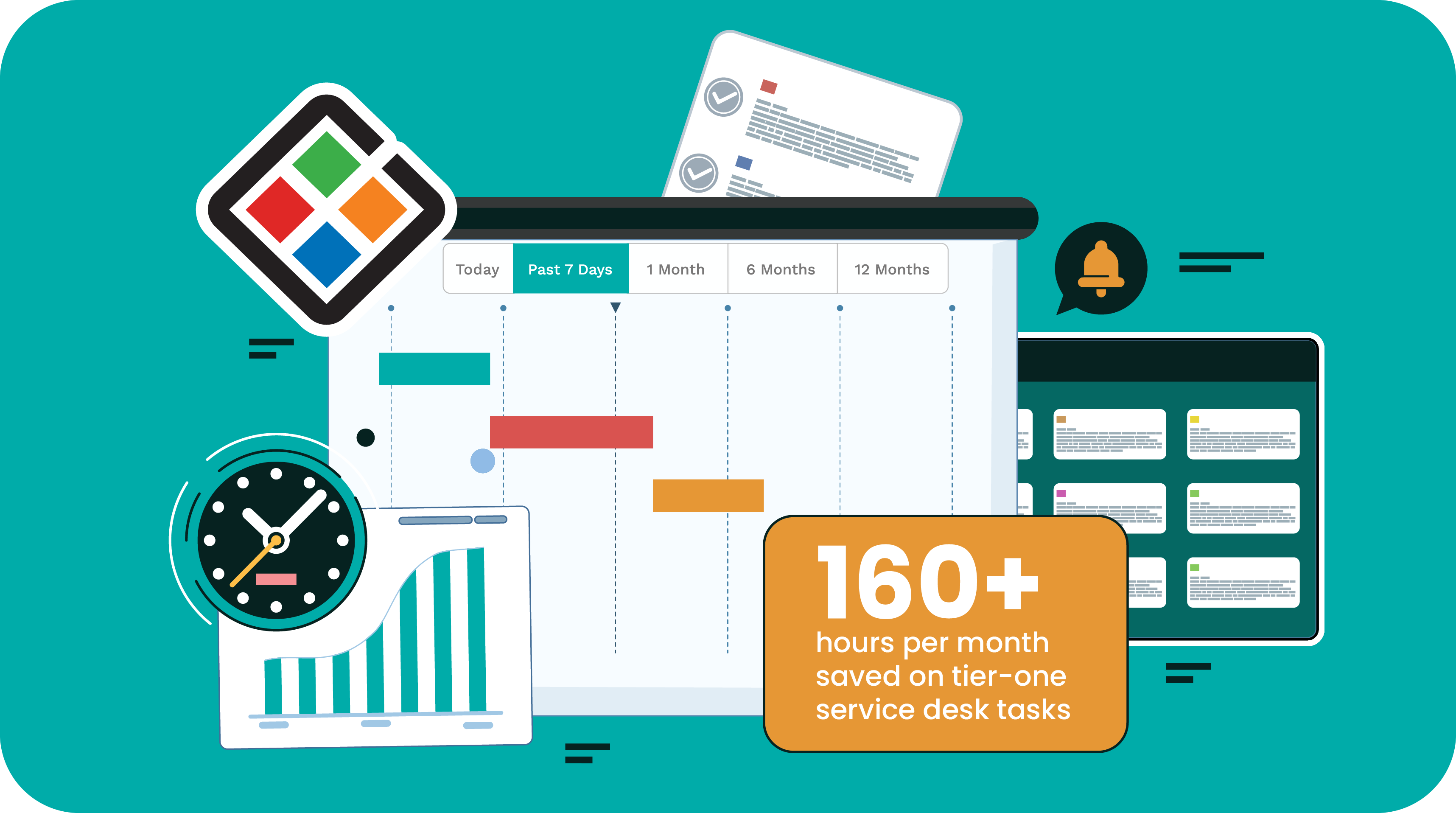
The recovered 160-plus hours a month give the team back a full-time employee's worth of capacity to put toward client work and higher-value tasks. That reinvested time is the return that makes the platform easy to justify internally.
That same value extends to clients. centrexIT has started delivering automation as a service, and its early client projects show the model's potential. For one client bound by state reporting requirements, three managers spent about six hours a day categorizing daily check-in forms by hand. Toby built a system that ingests the forms, processes them into a database, scans for anomalies, files everything in SharePoint, and produces weekly follow-up reports — an estimated $60,000 to $70,000 a year in savings for the client, from roughly four to five days of build time.
Those wins change the relationship. The client came back with more inquiries, and the conversation shifted from selling technology to demonstrating what automation could do for them. centrexIT is still maturing how it delivers the service, but the direction is set: the automation capability it built for itself is becoming a client-facing offering and a reason clients stay.

Strategic takeaway
Don't wait to start
centrexIT's results did not come from any one tool. They came from starting, and from building the foundations underneath: putting Rewst to work, earning adoption across the team, and standardizing how they build. As Josh puts it, there is never a perfect moment when every ticket is handled and every client is caught up, so you go for it. A year of that groundwork is what turned a handful of scattered wins into something the whole business now runs on.
The habit that made it scale was reuse. The team builds solid, general pieces once and adapts them, instead of rebuilding from scratch for every situation.
"Fundamentally a car works the same for everybody — 80% is identical, and the 20% is the features. We build good primitives in the first place so they're not highly customized to us, and then a lot of the legwork is just filling in the gaps." — Toby Peterson, centrexIT
For any MSP deciding whether to begin, the tools already in hand are enough. centrexIT runs on Rewst and Claude today, and what it built for itself now serves clients — a combination of capability, adoption, and know-how a competitor cannot stand up overnight.
Ready to build your own automation culture?
Hear CentrexIT's full playbook, from winning buy-in to scaling what works, in their on-demand session with Rewst.